Are you tired of expensive, pre-shredded cheese loaded with anti-caking agents and preservatives that compromise flavor and melt quality? Imagine effortlessly transforming a solid block of cheese into perfectly grated goodness in a matter of seconds. Using a food processor isn’t just a culinary hack; it’s a game-changer for anyone who values fresh ingredients, efficiency, and superior taste in their cooking. This comprehensive guide will walk you through everything you need to know, from selecting the ideal cheese to mastering the technique, ensuring you always have fresh, additive-free grated cheese at your fingertips.
Understanding Your Food Processor and Grating Cheese
Opting to grate your own cheese is a simple yet impactful decision that enhances both the flavor and healthfulness of your meals. Store-bought shredded cheeses often contain cellulose powder, potato starch, and other additives to prevent clumping, which can negatively affect their melting properties and overall taste. By grating cheese yourself, you gain full control over the ingredients, ensuring pure, unadulterated cheese every time.
The food processor truly shines as the best tool for this task, offering unparalleled speed and efficiency. What might take minutes of strenuous effort and potential knuckle scrapes with a hand grater can be accomplished in mere seconds with a food processor. It’s not only quicker but also significantly safer, reducing the risk of accidental injuries. Furthermore, a food processor handles larger quantities of cheese with ease, making it ideal for meal prepping or when cooking for a crowd.
For grating cheese, the critical components of your food processor are the shredding or grating disc, the feed tube, and the pusher. The shredding disc, typically a metal disc with raised perforations, is designed to rapidly break down solid foods into uniform shreds. Most food processors come equipped with at least one such disc, often offering different shred sizes like fine or medium. The feed tube is where you insert the cheese, and the pusher helps guide it down towards the spinning disc safely and effectively. Familiarizing yourself with these parts is the first step toward effortless cheese grating.
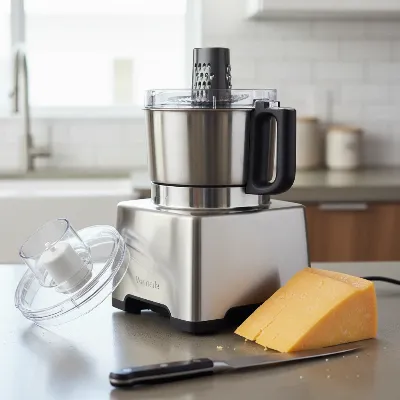 Food processor with shredding disc attachment and block of cheese for grating.
Choosing the Right Cheese and Preparation
The success of grating cheese in a food processor largely depends on the type of cheese you select and how you prepare it. Hard to semi-hard cheeses are the champions for food processor grating due to their firm texture, which resists clumping and allows for clean, consistent shreds. Varieties like Cheddar, Parmesan, aged Gouda, Gruyère, and even firm Mozzarella (low-moisture, part-skim) perform exceptionally well. These cheeses hold their shape as they pass through the shredding disc, resulting in distinct, fluffy shreds.
Conversely, softer cheeses with high moisture content, such as fresh mozzarella, brie, or goat cheese, are generally not suitable for food processors. Their creamy, pliable nature causes them to smear or clump into a paste rather than grate into fine shreds. If you absolutely must process a slightly softer cheese, a trick is to freeze it for a short period before grating.
A simple pre-freezing tip can significantly improve your grating results, especially for cheeses that are on the softer side of the “hard to semi-hard” spectrum. Place your block of cheese in the freezer for about 15 to 30 minutes before you plan to grate it. This brief chilling firms up the cheese, making it less likely to gum up the shredding disc and producing cleaner, more defined shreds. For very hard cheeses like Parmesan, some even recommend freezing until solid for a few hours to make them easier to process without overheating the motor.
Once your cheese is sufficiently chilled, the next crucial step is cutting it into manageable pieces. The goal is to create chunks or strips that fit comfortably into your food processor’s feed tube without forcing them. Typically, 1-inch cubes or rectangular strips that are roughly the width of your feed tube work best. This ensures even processing and prevents the machine from overworking, contributing to a longer lifespan for your appliance. Avoid trying to process overly large or oddly shaped pieces, as they can get stuck or lead to uneven results.
Step-by-Step Guide to Grating Cheese
With your cheese prepared and your food processor ready, you’re just moments away from a bounty of freshly grated cheese. Follow these simple steps for a smooth and efficient grating experience.
Step 1: Assemble Your Food Processor
|
Our Picks for the Best Food Processor in 2026
As an Amazon Associate I earn from qualifying purchases.
|
||
| Num | Product | Action |
|---|---|---|
| 1 | Ninja Food Processor, Professional Plus, 1000 Peak Watts, 4 Functions for Chopping, Slicing, Purees & Dough with 9-Cup Processor Bowl, 3 Blades, Food Chute & Pusher, Silver, BN601 |

|
| 2 | BLACK+DECKER 3-in-1 Easy Assembly 8-Cup Food Processor, Stainless Steel S-Blade, Easy-Clean, Touchpad Controls Black |
|
| 3 | Ninja Food Processor, Professional XL, 1200 Peak-Watts, 4-in-1, Chopping, Slicing/Shredding, Purees, Dough, 12-Cup Processor Bowl, 2 Blades & 2 Discs, Feed Chute/Pusher, Black, NF701 |
|
| 4 | Ninja Kitchen System | 8-Cup Food Processor Bowl & 72 oz. Blender All-in-One | With (2) 16 oz. To-Go Cups | For Smoothies, Ice Crushing, Dough & More | 1500 Watt | Black | BL770 |
|
| 5 | Cuisinart 5-cup Chop & Shred Food Processor, Silver, FP-5 |
|
| 6 | Hamilton Beach Stack & Snap Food Processor and Vegetable Chopper, BPA Free, Stainless Steel Blades, 12 Cup Bowl, 2-Speed 450 Watt Motor, Black (70725A) |
|
| 7 | Ninja BN600 Professional Food Processor (Renewed) |
|
| 8 | Hamilton Beach Food Processor & Vegetable Chopper for Slicing, Shredding, Mincing, and Puree, 8 Cup, Black |
|
| 9 | BLACK+DECKER 8-Cup Food Processor, Easy Assembly, Stainless Steel S-Blade, Shred, Slice, Chop, Puree, 450W Motor |
|
| 10 | Hamilton Beach Food Processor & Vegetable Chopper for Slicing, Shredding, Mincing, and Puree, 10 Cups + Easy Clean Bowl Scraper, Black and Stainless Steel (70730) |
|
First, ensure your food processor is properly assembled with the appropriate shredding disc. Remove the S-blade (chopping blade) if it’s currently installed, and securely place the shredding disc onto the central spindle. Most models have a reversible disc for fine or coarse shredding; choose the one that best suits your recipe. Then, firmly attach the lid, making sure it locks into place for safety. This setup creates the perfect environment for rapid grating.
Step 2: Load the Cheese
With the food processor lid secured, place your prepared cheese pieces into the feed tube. Do not turn the machine on yet. Arrange the cheese so that it sits neatly within the tube, ideally standing upright if they are strips, to ensure even contact with the shredding disc. Avoid overfilling the feed tube; it’s better to process in batches if you have a large quantity of cheese.
Step 3: Process the Cheese
Now, it’s time for the magic to happen. Turn on your food processor to its continuous “on” setting, or use the “pulse” function if you prefer more control. While the disc is spinning, use the food pusher to gently and steadily guide the cheese down through the feed tube. Apply firm but not excessive pressure. The key is to let the food processor do the work; forcing the cheese can strain the motor and lead to inconsistent shreds. You’ll hear the satisfying sound of the cheese being grated and see it accumulating in the bowl below.
Step 4: Monitor and Empty
Keep a close eye on the food processor bowl as the cheese is being grated. It’s important to stop processing before the bowl becomes overly full or the cheese starts to get compacted. If the shredded cheese becomes too dense, it can lose its light, fluffy texture and might even put undue stress on the motor. Once the bowl looks about two-thirds full or if you notice the cheese becoming compressed, turn off the machine, remove the lid, and transfer the grated cheese to a separate container. Repeat the process with any remaining cheese until all of your block is shredded.
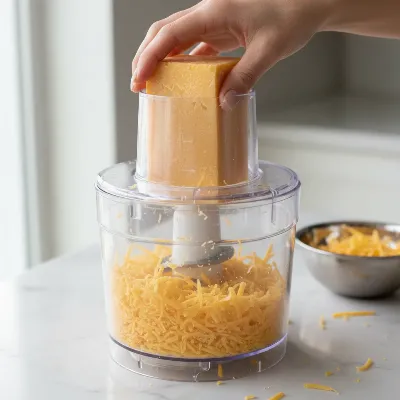 Hand pushing cheese into a food processor for grating.
Tips for Perfect Results Every Time
Achieving perfectly grated cheese consistently involves a few smart practices that can elevate your experience and outcomes.
- Chill Your Cheese: As mentioned, a brief stint in the freezer (15-30 minutes) can make a significant difference, especially for semi-hard cheeses like mozzarella. Colder cheese grates cleaner and is less likely to clump or stick to the disc.
- Don’t Overfill the Feed Tube or Bowl: Resist the urge to cram too much cheese into the feed tube at once, and always monitor the bowl. Processing in smaller, manageable batches prevents the machine from bogging down and ensures that your cheese remains light and fluffy, rather than becoming a dense, compacted mass.
- Clean Up Immediately: Cheese can be notoriously sticky once it dries, especially on plastic components. To make cleanup a breeze, rinse the food processor bowl, lid, and shredding disc immediately after use with warm, soapy water. This prevents cheese residue from hardening, saving you scrubbing time later. Most parts are top-rack dishwasher safe, but a quick hand rinse often suffices.
- Experiment with Shred Sizes: Your food processor likely comes with different shredding disc options – fine, medium, or coarse. Don’t be afraid to experiment! Fine shreds are excellent for delicate toppings or quick melting, while coarser shreds add texture to casseroles or heartier dishes. Matching the shred size to your recipe can significantly enhance the final dish.
Storing Your Freshly Grated Cheese
One of the great advantages of grating your own cheese is the ability to prepare a larger batch and store it for future use, saving you time during busy weeknights.
For short-term storage, freshly grated cheese can be kept in an airtight container or a resealable plastic bag in the refrigerator for up to 5-7 days. To prevent it from clumping, you can toss the cheese with a tiny amount (about a teaspoon per pound) of cornstarch or arrowroot powder before storing. This creates a light coating that inhibits moisture and prevents the shreds from sticking together.
For long-term storage, freezing is an excellent option that preserves the quality of your grated cheese for several months. Spread the freshly grated cheese in a single layer on a baking sheet lined with parchment paper and freeze for about 30-60 minutes, or until the shreds are firm. This step is crucial as it prevents the cheese from clumping together in a large block in the freezer. Once flash-frozen, transfer the cheese to freezer-safe bags or airtight containers, pressing out as much air as possible to prevent freezer burn. Label with the date and type of cheese. Frozen grated cheese can last for up to 3-6 months. When ready to use, you can usually add it directly to recipes without thawing, especially for dishes where it will be melted.
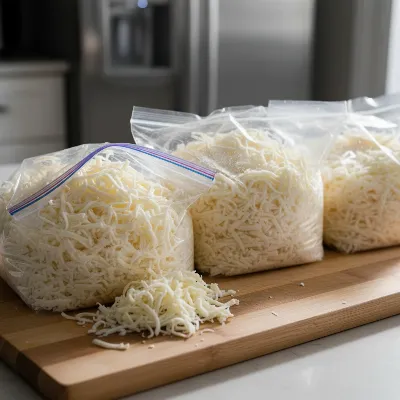 Freshly grated cheese packed into freezer bags for storage.
Troubleshooting Common Issues
Even with the best intentions, you might occasionally encounter a minor snag when grating cheese in a food processor. Here’s how to address some common issues:
- Cheese Clumping in the Bowl: If your cheese is clumping into a ball or paste, it’s likely too soft, too warm, or the bowl is overfilled. Try chilling the cheese longer in the freezer, ensuring it’s firm before processing. Also, process in smaller batches and empty the bowl more frequently to prevent over-compression.
- Cheese Not Grating Evenly or Leaving Large Chunks: This often happens if the cheese pieces are not uniform or don’t fit snugly in the feed tube. Cut your cheese into consistent sizes that fit well. Also, ensure you’re applying steady, even pressure with the pusher; inconsistent pressure can lead to uneven grating. Small un-grated pieces on top of the disc are normal and can be used in other dishes or simply discarded.
- Food Processor Struggling/Overheating: If your machine seems to be working too hard or making unusual noises, you might be processing too much cheese at once, or the cheese is too soft and creating too much resistance. Stop, clear the bowl, chill the cheese further, and process in smaller quantities. Ensure your shredding disc is sharp and correctly installed.
Conclusion
Mastering the art of grating cheese in a food processor is a simple skill that delivers significant culinary rewards. By embracing this quick and efficient DIY method, you unlock a world of fresher, purer flavors, free from the unnecessary additives found in pre-packaged alternatives. From selecting the perfect block of cheese and giving it a brief chill to understanding the proper technique and smart storage solutions, you now have all the knowledge to achieve perfect, fluffy shreds every time. This simple kitchen upgrade saves time, reduces waste, and elevates your home cooking, making everyday meals and gourmet dishes alike taste extraordinary. So, grab that block of cheese, power up your food processor, and savor the difference! What delicious dish will you create first with your freshly grated cheese?
Frequently Asked Questions
Can I grate all types of cheese in a food processor?
No, hard to semi-hard cheeses like cheddar, Parmesan, and Gruyère work best. Soft cheeses with high moisture content, such as fresh mozzarella or brie, tend to clump and smear rather than grate evenly.
Is it necessary to chill the cheese before grating?
While not always strictly necessary for very hard cheeses, chilling your cheese in the freezer for 15-30 minutes beforehand is highly recommended. It firms up the cheese, leading to cleaner, fluffier shreds and preventing it from clumping or sticking to the food processor’s blade.
How long does freshly grated cheese last?
Freshly grated cheese can be stored in an airtight container in the refrigerator for up to 5-7 days. For longer storage, flash-freeze the cheese in a single layer before transferring it to freezer bags, where it can last for 3-6 months.
Can I use the regular S-blade to grate cheese?
No, the regular S-blade (chopping blade) is designed for chopping, mixing, or pureeing, not grating. Using it for cheese will result in a paste-like consistency rather than distinct shreds. Always use the specific shredding or grating disc attachment for best results.
What if my food processor bowl gets too full while grating?
It’s important to monitor the bowl and stop the machine before it becomes overly full or the cheese starts to compact. Overfilling can lead to dense, clumpy cheese and may strain the motor. Empty the bowl and continue processing in batches for optimal results.
